
- Food Pro ERP
- Bakery ERP
- Dairy ERP
Bakery ERP Software for Bakery Chains in Kerala
By nine in the morning, a bakery with five outlets has already made a hundred small decisions: how many trays of puffs go to each shop, whether yesterday's cream cakes can go out again, which outlet called for more bread. JMJ Bakery ERP puts those decisions on one screen.
It is bakery management software for bakeries that make their own products and sell through several outlets, a café, vans or wholesale customers. The factory, the stores, every outlet counter and the van team work from the same stock, the same recipes and the same numbers.
- Bakery chains
- Central factories
- Bakery cafés
- Cake shops
- Van and wholesale supply

What is a bakery ERP?
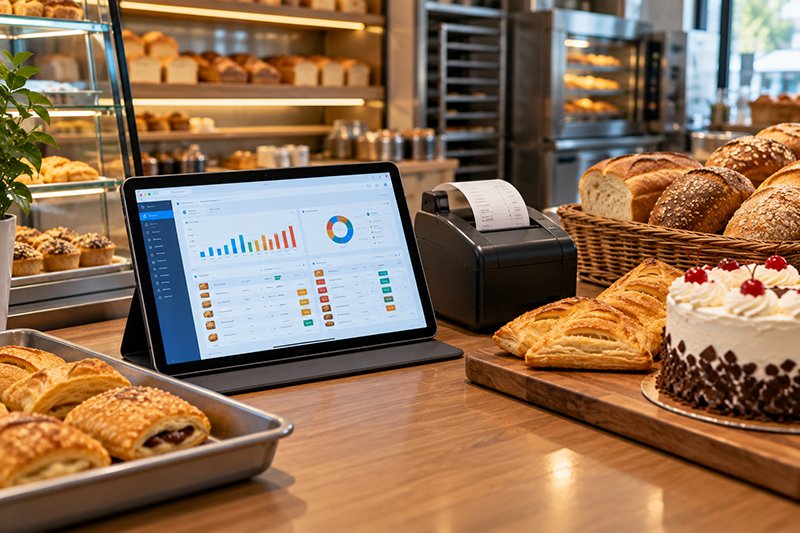
A bakery ERP is software that connects a bakery's raw material stores, recipes, production, dispatch, outlet billing and accounts, so every product's stock and cost can be followed from the factory to the counter.
JMJ Bakery ERP is the bakery edition of JMJ Food Pro ERP, the food production platform from JMJ Software Solutions. Food Pro ERP supplies the recipe, batch, inventory and costing core. The bakery edition adds what a chain needs on top: allocation to outlets, a bakery POS, café billing, van sales and outlet-level reports.
- Built for
- Bakeries with a factory and outlets
- Part of
- JMJ Food Pro ERP
- Deployment
- Cloud, on subscription
- Mobile
- Owner app and van sales app
- Tax
- GST e-invoice from sales entries
- Support
- JMJ team in Kochi

From the first tray out of the oven to the last bill at the counter.
Where a growing bakery starts losing control
These are common patterns in bakeries that have outgrown spreadsheets and a billing counter. Each one is matched to the part of JMJ Bakery ERP that deals with it.

Recipe costs are guessed in an old Excel sheet while flour, butter and sugar prices move every week
What it costsSelling prices are set on costs that are months out of date, so margin on some items quietly disappears.
What the system doesMulti-level recipes and batch costing from what each batch actually consumed. When ingredient costs change, item costs are recalculated.
What to bake each morning is decided by whoever is on shift, from outlet phone calls
What it costsPopular items run out by noon while others come back unsold in the evening.
What the system doesA suggested production plan built from sales orders, pre-orders, outlet requirements and current stock.
Cream, fruit and flour are used in whatever order they come off the shelf
What it costsPerishable stock expires in the store, and spoilage becomes a silent daily loss.
What the system doesBatch and expiry tracking on raw, semi-finished and finished goods, with FEFO or FIFO issue and alerts for items nearing expiry.
Dough, frosting and fillings are not tracked as stock at all
What it costsInventory and costing do not add up, because a large share of the work in progress is invisible.
What the system doesSemi-finished goods as their own stock items, with multi-stage production and work-in-progress tracking.
The factory says 40 trays went out; the outlet says 38 arrived
What it costsStock differences between factory and outlets cannot be explained, so wastage and theft look the same.
What the system doesAllocation to each outlet, dispatch by container and vehicle, and QR code stickers carrying batch, manufacturing and expiry dates.
Counter sales, phone pre-orders, café bills and wholesale orders sit in different books
What it costsProduction cannot be planned from real demand, and nobody has one view of the day's sales.
What the system doesOutlet POS, central order management for pre-orders, café billing and a distribution module for B2B customers, all drawing on the same central stock.
Bakery billing software or a bakery ERP?
If you run one shop and bake at the back, a good billing system is probably all you need. Things change once a central factory supplies several outlets. The money is no longer lost at the counter. It is lost in between: between what the factory made and what each outlet received, between what was sent and what was sold, and between what an item costs today and what the costing sheet still says.
This comparison describes the two categories of software in general. It is buyer guidance, not a review of any other product.
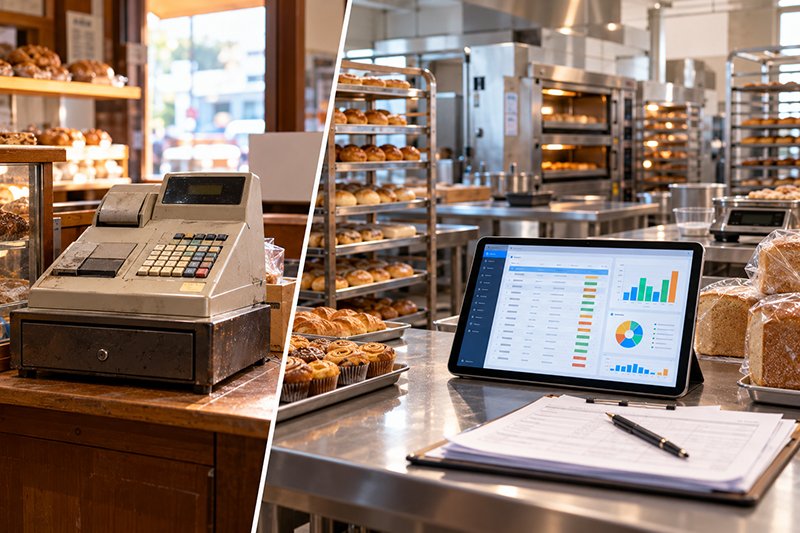
| Question | Billing / POS software | Bakery ERP |
|---|---|---|
| What was sold today? | Yes, per counter | Yes, per outlet, café, van and wholesale customer |
| What did this batch cost to make? | Usually not | Yes, from recipe and actual consumption |
| What should the factory bake tomorrow? | No | Suggested plan from orders, outlet needs and stock |
| Which raw material lot went into this cake? | No | Yes, batch linked to recipe and ingredients |
| How much did each outlet waste? | Rarely | Wastage and variance reports |
| Do the books need re-typing? | Often | Accounts and GST e-invoices from the same entries |
How stock moves from the factory to the counter
Every step uses the same items, batches and prices. When an outlet sells a black forest cake, outlet stock, the sales report and tomorrow's production plan all reflect it.
- Raw material storesFlour, fats, dairy, chocolate, packing and consumables, by batch and expiry.
- Production planningOrders, pre-orders, outlet needs and stock become a plan and work orders.
- Production & batchesMaterials issued, yield recorded, QC hold, release, rework or rejection.
- Finished goods & dispatchAllocated to outlets, packed by container and vehicle, QR-labelled.
- Outlets, café & vansPOS billing, café orders, van sales and wholesale, on one stock.
- Reports & accountsSales, wastage, costing, outstanding and GST e-invoices.
What JMJ Bakery ERP covers
The full module list, grouped the way a bakery is organised: the factory, the road between factory and outlet, the counter, and head office.

In the factory
Raw material and packing stores
Flour, sugar, butter and fats, milk products, eggs, chocolate, dry fruits, flavourings, packing materials and everyday consumables, all tracked in the same inventory.
- Multiple units of measure: buy a 50 kg flour bag, issue it by the kilogram
- Supplier-wise purchase rates
- Batch or lot numbers with manufacturing and expiry dates
- FEFO or FIFO issue, so the soonest-to-expire or oldest stock goes first
- Reorder levels and reorder alerts
- Location-wise stock across several stores
- Stock ageing and stock valuation at any time
Why it matters: perishable ingredients are where a bakery's margin leaks first. Knowing what is close to expiry, and issuing it first, keeps it out of the bin.
Production planning
Plans are built from sales orders, pre-orders, outlet requirements and the stock already on hand.
- Demand-based planning and festive-season planning
- Product-wise and batch-wise schedules
- Machine and manpower planning for each shift
- Work orders issued to the production floor
- Daily or weekly plans generated from orders
Why it matters: a plan based on real demand reduces both stock-outs of popular items and unsold trays at closing time.
Production, batches and quality
Each work order is followed from material issue to finished batch.
- Material issue from stores against each work order
- Planned yield compared with actual yield
- Work in progress and multi-stage production
- Semi-finished items such as dough, cream and fillings
- Quality check with hold and release of batches
- Rework and rejection recorded against the batch
- Every batch linked to its recipe and the ingredient lots used
Why it matters: yield variance shows where material is being lost, and batch links make a quality complaint traceable.
Recipes and costing
Each product has a recipe (bill of materials), which can include semi-finished components.
- Multi-level recipes, scaled to any batch size
- Material requirements calculated for a planned batch
- Batch costing from raw materials actually consumed, labour and overheads
- Item costs recalculated when raw material costs change
Why it matters: pricing and promotions can be decided on today's cost, not last year's.
Between the factory and the outlets
Finished goods allocation
Finished goods are allocated to each outlet automatically, based on what that outlet holds and needs. The factory can see what is sitting at each outlet, and each outlet can see what is on its way.
Why it matters: stock goes where it will sell, instead of where someone remembered to send it.
Dispatch by container and vehicle
Dispatch is grouped by container and vehicle. Each container gets a QR code sticker showing its batch, manufacturing date and expiry date.
Why it matters: what left the factory and what reached the outlet can be matched, so differences can be explained.
Van sales app
Van staff use a mobile app on their route.
- Take orders and check each shop's history, prices and dues
- See what is left in the van
- Collect payment by cash, card or UPI
- Planned routes and visit tracking
- Keeps working without network and syncs later
Why it matters: route sales and collections are visible the same day, not after the van returns.
Pre-orders and wholesale orders
A central order management module handles phone and counter pre-orders, and a distribution module handles B2B customers such as shops and institutions. Both draw on the same central inventory as the outlets.
Why it matters: every order feeds the production plan, so a large cake order or an institutional supply is not a surprise to the factory.
At the outlet counter and café
Bakery POS and billing
A POS built for a busy bakery counter. Every sale syncs with the central system.
- Barcode billing, and sale by weight or by piece
- Combos and offers
- Hold and recall a bill while a customer decides; reprint
- Returns with automatic stock update
- Cash, card, UPI or wallet, and split payment on one bill
- Day close and shift reports
Café management
If the bakery runs a café, it works on the same system.
- Table management for dine-in
- Takeaway orders
- Kitchen updates
- Café stock that reduces as items are sold
Why it matters: café sales and stock appear in the same reports as the outlets, instead of in a separate system.
Head office control
Multi-location operations
The factory, every store, every outlet, the café and each van are set up as locations in one system, with stock visible for each.
Reports and MIS
- Factory: production, wastage and variance, batch and expiry, raw material use, machine and staff efficiency
- Outlets: sales by outlet and product, outlet stock, discounts and offers, customer and loyalty, daily closing
- Café: daily sales, peak hours, payment modes, best and worst sellers
- Purchase and accounts: supplier reports, pending orders, ledgers, receivables, payables, profit and loss
- Inventory: stock position, batch-wise stock, transfers, expiry, reorder suggestions
Roles, access and audit trail
Access is role-based. A cashier sees the counter, a store manager sees the stores, and only the people you choose see profit figures. Accounting entries keep an audit trail of who changed what.
Accounts, GST e-invoice, cloud and mobile
Accounts are updated from the same purchase and sales entries, and GST e-invoices are generated from them. The system runs in the cloud on a subscription, and the owner's mobile app shows any outlet's sales, stock and reports.
Planning for Onam, Christmas and wedding season
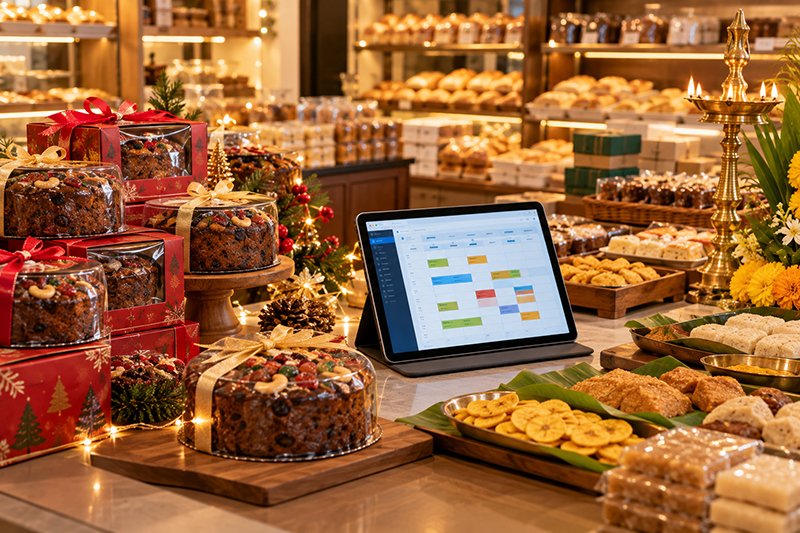
For many Kerala bakeries, a handful of weeks decide the year. Plum cakes in December, sweets and snacks around Onam, celebration cakes through the wedding season. Those weeks are usually planned on paper, with fingers crossed on raw material stock.
JMJ Bakery ERP supports demand and festive-season planning. Pre-orders and expected outlet demand go into the production plan. The recipes for planned quantities show how much flour, butter, dry fruit and packing material the season will need, compared with what is already in the stores. That leaves time to buy at the right price, instead of in a hurry.
A practical step: when you book a demo, bring last season's best-selling items and approximate quantities. The demo can show how those would be planned and costed in the system.
What a bakery can expect to gain
These are the outcomes the documented features are designed to support. Actual results depend on how a bakery uses the system; JMJ does not publish percentage claims.
- Current product costsBatch costing from actual consumption, so price decisions use today's cost.
- Better visibility of wastageWastage and variance reported by factory and outlet, so it can be managed rather than guessed.
- Fewer morning phone callsOutlet requirements and allocations are in the system, not on the phone.
- Less spoilage of perishablesFEFO issue and expiry alerts help use stock before it expires.
- One view of every sales channelOutlets, café, vans and wholesale reported together.
- Less duplicate entryAccounts and GST e-invoices come from the same entries as sales and purchases.
- Owner visibility from anywhereMobile app access to sales, stock and reports.
Who JMJ Bakery ERP is built for
JMJ Bakery ERP is already running at a multi-outlet bakery chain. It fits bakeries that make and sell their own products across more than one point of sale.
Bakery chains with a central factory
Several outlets supplied from one production unit, with allocation and dispatch every day.
Bakeries with a café
Dine-in and takeaway on the same stock and reports as the counter.
Cake shops and confectioneries
Pre-orders for celebration cakes alongside daily counter sales and wholesale supply.
Bakeries with vans and institutional supply
Route sales to shops and institutions, with van stock and collections on the app.
Bakeries about to open another outlet
Put the system in place before the next outlet opens, rather than after the problems start.
Running a single shop with no separate production unit? A bakery ERP may be more than you need. Ask the JMJ team; they will tell you honestly.
What to check before choosing bakery software
Use these questions with any vendor, including JMJ. They are general buyer guidance based on how bakery chains operate.
- Does it cost a batch, or only record a sale?Ask to see a recipe with semi-finished items and its cost change when an ingredient price changes.
- How does stock move from factory to outlet?Look for outlet allocation, dispatch records and a way to match what was sent with what arrived.
- Can it handle expiry?Check batch and expiry dates on raw, semi-finished and finished goods, and FEFO issue.
- Will the counter keep up at peak time?Test barcode and weight-based billing, combos, held bills and split payment.
- Does the café need a separate system?If it does, café sales and stock will not appear with the outlets.
- What happens on the van when the network drops?Ask whether the van app works offline and syncs later.
- Who can see profit figures?Role-based access and an audit trail matter once several people use the system.
- Who supports you after go-live, and from where?For a Kerala bakery, a support team in Kerala makes on-site visits practical.
How JMJ sets up a bakery
The steps below are JMJ's documented approach. The timeline depends on the number of outlets, products and records, and is agreed after the first process review.
- Understand the bakeryHow production, stores, outlets, café and vans work today.
- Set upItems, recipes, outlets, users and permissions.
- Move your dataExisting data migrated and checked with you before go-live.
- Train each teamFactory, cashiers, café, accounts; on-site or remote.
- Go live and supportDedicated support, updates, refresher training and changes.
Why Kerala bakeries talk to JMJ
It is already running at a bakery chain. JMJ Bakery ERP is in use at a multi-outlet bakery chain. Factory, outlets, café and vans were part of the design from the start.
The team is in Kerala. JMJ's Kochi office supports bakeries across the state, from Kochi to Thrissur and Kozhikode, and can be on site when something needs to be seen in person.
It is built on a long track record. JMJ Software Solutions has been building business software since 1998, with more than 250 projects delivered for over 100 customers.
It can follow your process. Reports and features can be added or adjusted, because every bakery runs a little differently.
What is bakery ERP software?
Bakery ERP software is a business system that runs a bakery's raw material stores, recipes, production, dispatch to outlets, outlet billing, café, van sales, accounts and reports from one set of records. Billing software only records the sale; a bakery ERP also follows the stock and the cost behind it.
Which software is best for a bakery business?
It depends on how the bakery is set up. A single shop that bakes on site usually needs a good POS with stock. A bakery with a central factory supplying several outlets, a café, vans or wholesale customers needs an ERP that links production, outlet stock and sales, because costing, wastage and dispatch are where that kind of business loses control.
How do I manage several bakery outlets from one place?
Put the factory and every outlet on the same system. In JMJ Bakery ERP, outlet requirements feed the production plan, finished goods are allocated to each outlet, every outlet bills on the same POS, and head office sees sales, stock and wastage for each outlet centrally and on the mobile app.
What is the difference between bakery billing software and a bakery ERP?
Billing software records sales at the counter. A bakery ERP also manages raw material stores, recipes and costing, production planning, batches and quality checks, dispatch to outlets, van sales, accounts and reports. In JMJ Bakery ERP the outlet POS is one part of that system.
Can JMJ Bakery ERP plan production for Onam, Christmas and other peak seasons?
Yes. Production planning takes in sales orders, pre-orders, outlet requirements and current stock, and supports demand and festive-season planning, so raw material needs and work orders for peak periods can be planned ahead.
Does it track semi-finished items like dough, cream and fillings?
Yes. Recipes can be multi-level and production can run in several stages, so semi-finished items are recorded and costed separately from finished products.
Can I check my outlets from my phone?
Yes. JMJ Bakery ERP runs in the cloud and includes a mobile app, so owners can check outlet sales, stock and reports from anywhere.
Does it support GST e-invoicing?
Yes. GST e-invoices are generated from the same sales entries, so accounts staff do not re-enter invoices.
How much does bakery ERP software cost?
JMJ Bakery ERP is offered on a subscription. The price depends on your setup, such as the number of outlets, users and modules, so the JMJ team gives a quote after understanding how your bakery runs. Send your requirements to get one.
Is the software available in Malayalam?
No. The software screens are in English. Training and support are provided by the JMJ team from the Kochi office.
Can the system be changed to suit how our bakery works?
Yes. JMJ offers customisation, so reports and features can be added or adjusted when your process needs it. Discuss specific changes with the JMJ team during the requirement review.
Related products and pages
Other JMJ products and pages that work alongside this one.
See one product travel from your factory to your counter
In about 30 minutes, the JMJ team follows one of your products from a production batch in the factory to a bill at the outlet, using a setup close to yours. Bring a recipe and an outlet list.
Prefer to talk? Call +91 88938 89777, email info@jmjsoft.com or message us on WhatsApp.
