
- Food Pro ERP
- Bakery ERP
- Dairy ERP
Dairy ERP Software for Private Dairies and Milk Processors
A dairy runs on a clock most businesses never face. Milk comes in from hundreds of farmers before sunrise, is tested and processed within hours, and has to be on the road again before it turns. Then every one of those farmers must be paid the right amount.
JMJ Dairy ERP is dairy management software that follows all of it: what came in, from whom and at what quality; what it became; where it went; and who still owes you for it. It is built on JMJ Food Pro ERP and supported from Kochi.
- Private dairies
- Milk processing plants
- Ghee, curd & paneer makers
- Ice cream producers

What does a dairy ERP do that accounting software cannot?
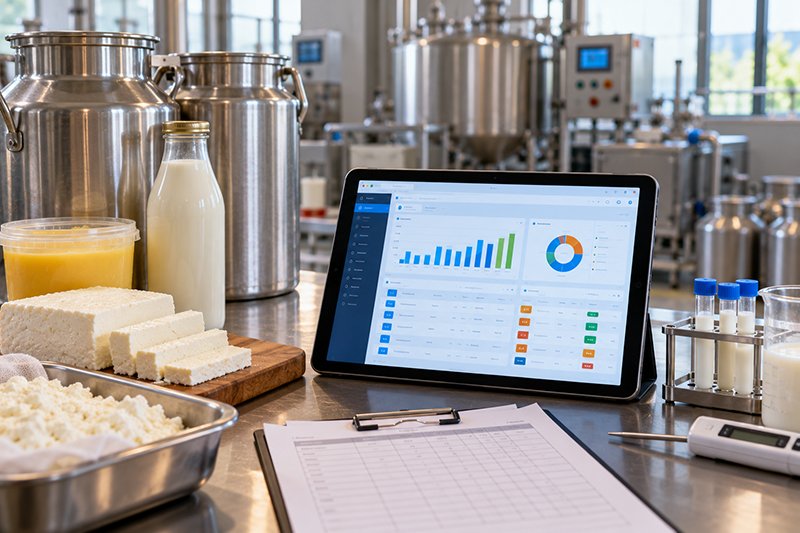
Accounting software follows the money. A dairy ERP follows the milk as well: from the collection centre through processing, cold storage and routes, to the farmer's payment and the retailer's outstanding balance.
A dairy needs to know that a quantity of milk came from one collection centre this morning at a certain Fat and SNF; that part became curd and part became cream; that the cream went into ghee; and that the ghee went out on a route with crates that have not come back yet. JMJ Dairy ERP holds that chain together. Accounts are still part of it; they stop being the only part.
- Built for
- Private dairies and processors
- Part of
- JMJ Food Pro ERP
- In use at
- A private dairy
- Deployment
- Cloud, on subscription
- Mobile
- Van sales and owner apps
- Support
- JMJ team in Kochi

Every litre followed, from the collection centre to the customer.
Where dairies quietly lose margin
A dairy balances a perishable raw material with a perishable finished product. Margin leaks at three stages: procurement, processing and distribution.

Milk procurement runs on spreadsheets, with rates calculated by hand from Fat/SNF
What it costsOne wrong formula and the dispute lands at the collection centre.
What the system doesCollections recorded with quantity and quality at each centre; rates applied from your custom Fat/SNF chart.
Farmer payments are slow, error-prone and a source of disputes
What it costsHours of admin work and strained farmer relationships.
What the system doesAccurate payment statements generated for each farmer.
You know how much milk went in, but not what the paneer, ghee or curd really cost
What it costsPrices and product mix are decided without true product margins.
What the system doesMulti-stage production with by-product management and input cost allocation.
Van routes are a black box, with stale returns and lost crates
What it costsSales are only clear at night; crates and cans go out and fewer come back.
What the system doesVan sales app for route inventory, spot invoices and returns, plus crate and can tracking.
Short shelf-life stock sits in cold storage a day too long
What it costsA day's delay can mean a total loss.
What the system doesBatch and expiry tracking, FEFO picking and short-expiry alerts.
A quality complaint cannot be traced back to the collection centre
What it costsInvestigations take an afternoon and recalls are broader than they need to be.
What the system doesBatch traceability from collection centre to retailer.
From the collection centre to the bank
Every step uses the same records, so the farmer's payment, the product's cost and the route's outstanding balance come from one place instead of three spreadsheets.
- Collection centresQuantity, Fat and SNF recorded for each farmer.
- Reception & testingQuality recorded on incoming milk.
- ProcessingMulti-stage production and by-products.
- Cold storageBatch and expiry, FEFO picking.
- Routes & customersVan sales, agents, retailers, institutions.
- Payments & accountsFarmer statements, collections, GST e-invoice.
The eight areas JMJ Dairy ERP covers
From milk procurement to business intelligence, each area works on the same data.
Milk procurement and collection
Digitise the collection process. Each collection centre logs milk quantity and quality (Fat and SNF) for every farmer. That one entry feeds stock, costing and the farmer's account.
Why it matters: the morning's data is captured once, where it happens, instead of being re-typed at the office.
Automated farmer payments
- Rate calculated automatically from your custom Fat/SNF rate charts
- Exact amount per collection, totalled per payment cycle
- Accurate payment statements for each farmer
Why it matters: clear statements reduce disputes, and the office stops recalculating by hand.
Production and batch costing
Raw milk becomes toned milk, cream, curd, paneer, ghee, butter or ice cream, often in several stages.
- Multi-stage production
- By-product management, such as cream
- Cost of inputs (milk, culture, energy) tracked and allocated across outputs
- Profitability on every batch
Quality control and compliance
Quality is recorded on incoming milk and on production batches, and every product can be traced back through its batch to the milk it came from.
Cold chain and expiry control (FEFO)
- Batch and expiry tracking on every product
- First-expiry, first-out picking rules enforced
- Automated alerts for short-expiry stock
Why it matters: perishable stock is sold in the right order, before it becomes a return. See cold storage management below.
Sales, distribution and van sales
- Routes, agents, retailers and institutional customers
- Van sales app: route inventory, on-the-spot invoices, returns
- Crate and can tracking to stop asset loss
- Collections recorded against each customer
Finance and accounts
Purchases, farmer payments, sales and collections post to accounts as they happen. GST e-invoices come from the same entries.
Business intelligence and analytics
Collection by centre, production yield, profit by product, route sales, returns, outstanding and stock, with access limited by role.
Mobile apps and portals
Mobile apps for owners and route staff, so numbers are entered where the work happens and visible wherever you are. Portal access is discussed during the requirement review.
Cold storage management
For chilled and frozen stock, where the cost of a mistake is spoilage. The same rules apply in a dairy's own cold room or a third-party cold store handling milk, ice cream or other perishables.
FEFO at the point of picking
- The pick list sends the worker to the batch that expires first
- It is the rule, not a suggestion
Batch traceability
- Every movement logged
- Trace a finished batch back to its raw material batch, or forward to every customer
- Audit reports straight from the system
QC and temperature hold
- Put any item, pallet or batch on hold
- Held stock cannot be picked or sold until a manager releases it
Directed put-away
- The system tells staff where to store incoming stock
- By rule (dairy in Zone A, pharma in Zone B) or by available space
The same cold storage controls are used for temperature-sensitive medicines in JMJ Pharma ERP and for perishables in Food Pro ERP.
How Fat/SNF payment works, in plain terms
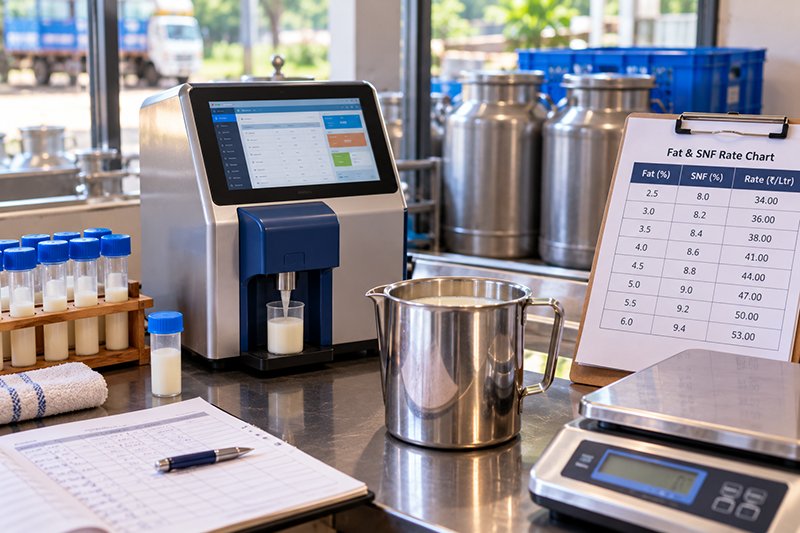
Milk is paid for by quality as well as quantity. Two readings matter most: the fat percentage and the SNF (solids-not-fat) percentage. A dairy's rate chart sets a price per litre for each combination of the two.
At the collection centre, each farmer's milk is measured and tested. Multiply the litres by the rate for that Fat/SNF combination and you have the value of that collection. Repeat that twice a day, for hundreds of farmers, over a payment cycle, and the arithmetic becomes the biggest administrative job in the dairy.
In JMJ Dairy ERP, the rate chart is set up once. Every recorded collection is priced automatically, and each farmer's statement is ready at the end of the cycle.
This explanation describes common dairy practice in general terms. Your own rate charts and payment cycles are configured during setup.
What a dairy can expect to gain
Outcomes supported by the documented features. Results depend on each dairy's operation.
- Fewer payment disputesStatements built from recorded collections and your own rate chart.
- True product marginsInput costs allocated across main products and by-products.
- Route sales visible the same dayVan invoices, returns and collections recorded on the route.
- Fewer lost crates and cansAssets tracked on every trip.
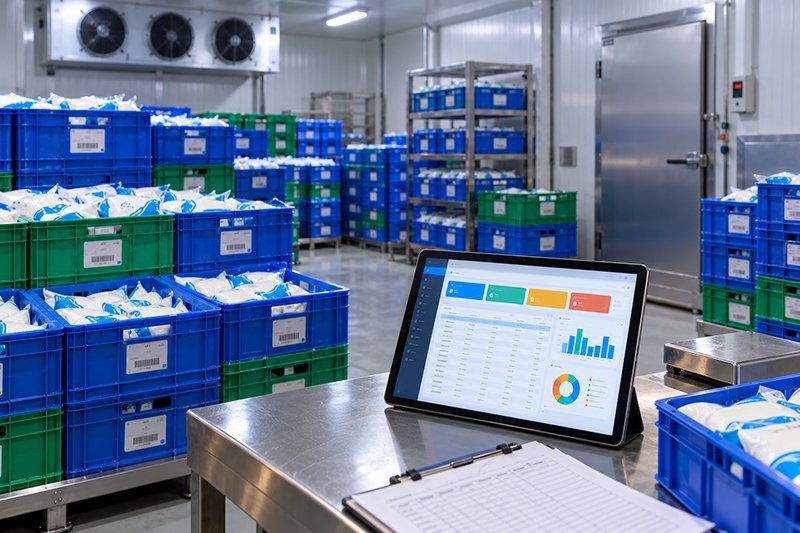
- Less short-shelf-life lossFEFO picking and expiry alerts.
- Faster traceabilityBatches linked back to collection records.
Who JMJ Dairy ERP is for
Private dairies buying from farmers
Procurement through collection centres, with rate-chart payments.
Milk processing plants
Milk, curd, paneer, ghee and butter made in several stages.
Ice cream and dairy product makers
Batch production with cold chain and expiry control.
Dairies selling through vans and agents
Route sales, returns, crates, cans and collections.
Questions to ask any dairy software vendor
General guidance for private dairies comparing systems.
- Can it use our own rate chart?Rate charts differ by dairy and season; they should be configurable, not fixed.
- Are farmer statements automatic?Ask to see a statement built from a cycle of collections.
- How are by-products costed?Cream and its products should carry a share of input cost.
- Does the van app handle returns and crates?Stale returns and missing crates are routine losses.
- Is FEFO enforced in cold storage?Picking rules matter more than expiry reports.
- Can a batch be traced to its collection centre?Test it during the demo.
Getting started
The timeline depends on your collection network, products and routes, and is agreed after the first review.

- Learn your dairyCollection centres, rate charts, products and routes.
- ConfigureRate charts, products, routes, users and permissions.
- Bring in dataFarmers, customers and opening balances, checked with you.
- TrainCollection, plant, sales and accounts staff, on-site or remote.
- SupportRemote support, updates and changes when rules change.
Why dairies talk to JMJ
JMJ has done this before. JMJ built and supports a dairy ERP for a private dairy as a long-term engagement, covering procurement, production, quality, sales, distribution and collections.
The team is close by. JMJ's Kochi office supports dairies across Kerala and can visit when something needs to be seen in person.
A long track record. JMJ Software Solutions has been building business software since 1998, with more than 250 projects for over 100 customers.
Questions dairies ask
What is dairy ERP software?
Dairy ERP software records a dairy's milk procurement, farmer payments, processing, quality checks, cold storage, distribution, collections and accounts in one system. Because every step uses the same records, farmer payments, product costs and route outstanding all come from one source.
How is the milk rate calculated from Fat and SNF?
Most dairies use a rate chart that sets a price per litre for each combination of Fat and SNF percentage. JMJ Dairy ERP applies your own rate chart to every collection automatically, using the quantity and quality recorded at the collection centre, and adds up each farmer's total for the payment cycle.
Does JMJ Dairy ERP generate farmer payment statements?
Yes. The system builds a payment statement for each farmer from that farmer's recorded collections and your rate chart, so the office does not recalculate payments by hand.
Can it cost cream, ghee, paneer and other by-products?
Yes. Production can run in several stages, and the cost of inputs such as milk, culture and energy is allocated across everything produced from it, including by-products like cream, so the profit on each product and batch is visible.
We are a private dairy, not a cooperative. Will it fit?
Yes. JMJ Dairy ERP is in use at a private dairy, covering procurement, production, quality, sales, distribution and collections, and it is set up around each dairy's own rate charts, products and routes.
Is there an app for route sales?
Yes. Van sales staff manage route inventory, generate invoices on the spot and record returns from a mobile device. Crates and cans are tracked on every route.
How does it reduce losses from short shelf-life stock?
Every batch carries its expiry date. The system enforces first-expiry, first-out picking and sends alerts for short-expiry stock, so products are sold in the right order.
Can a batch be traced back to the collection centre?
Yes. Batch tracking links products to the milk and collection records they came from, so a quality complaint can be traced back from the retailer.
Does it support GST e-invoicing?
Yes. GST e-invoices are generated from the same sales entries.
How much does dairy ERP software cost?
JMJ Dairy ERP is offered on a subscription, priced according to your setup. The JMJ team quotes after understanding your collection network, products and routes. Send your requirements.
Related products and pages
Other JMJ products and pages that work alongside this one.
Walk through one day at a dairy like yours
In about 30 minutes: a morning collection, the farmer payment it creates, a production batch, and the evening route settlement.
Prefer to talk? Call +91 88938 89777, email info@jmjsoft.com or message us on WhatsApp.
